

Very Nice...
How did you achieve, on the counter top, the bluish frosted lit glass? Is there an emitter in side the glass box?
Thanks,
Aaron

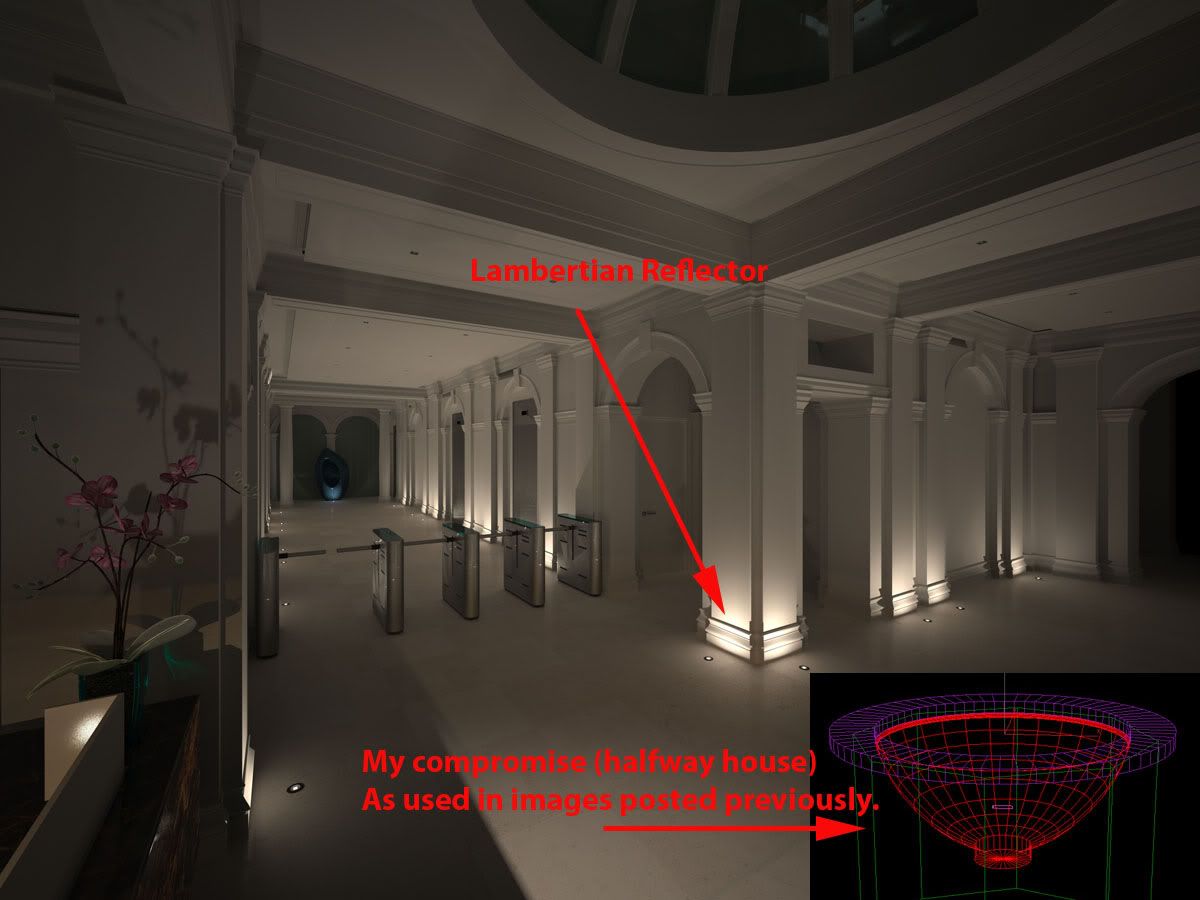
It is yes. As my first job in Maxwell I approached it directly as a physically correct renderer without realising the inherent limitations in the caustics component, and its no so 'physical' nature. In fact myself and an old timer 3d friend of mine have been looking at lighting more closely as a result of these caveats in Maxwell regarding lighting rigs; not having emitters in glass etc... etc.. he believes a lambertian reflector (hidden to camera), with a shiny reflector clone (hidden to gi) is the best optimum (low noise/ speed) and indeed this is significantly quicker. After experimenting alot on the back of this job I have found a halfway compromise to work best for me. A tiny 3 sided cylinder emitter positioned in the same place as the bulb filament would be with a shiny 'faceted' reflector gives a good result. You can see from the attached image that the lambertian version, although noiseless, is also slightly simplistic; and I prefer the caustic falloff component which is closer to reality of my rig. To a degree the falloff can be simulated (as my friend pointed out) by having a 'skirt' attached to the lambertian version, with different designs of clipmap attached around the edge of the reflector. Although with enough rendering power at the office I am lucky not to have to worry about this level of trickery!Asmithey wrote:Very Nice...
How did you achieve, on the counter top, the bluish frosted lit glass? Is there an emitter in side the glass box?
Thanks,
Aaron
 - By Matteo Villa
With no support to Blackwell RTX 5000 we had to sw[…]