All posts relating to Maxwell Render 1.x
User avatar
By iker
#276065
Thank you very much KurtS! :D
Definitely one of the best cg glass scenes I've ever seen
User avatar
By oz42
#276071
Sorry to come in late to the party but I just spotted this thread and I'm intrigued.

KurtS render is, as iker says, one of the best CG glasses I've seen and so I'm sure his method is correct but as pipcleo says, it's very counterintuitive.

Am I right in understanding from KurtS vector drawing on page 2 that there is a very, very small gap between the flat top surface of the liquid and the flat inner surface of the 'glass', as shown in Thomas An's diagram towards the bottom of page 1?

Also, is it correct to have the meniscus modelled on both the glass and the liquid? (This differs from Thomas's diagram but seems to work in KurtS great render)

I've been modelling slightly differently (with an open glass mesh) and it seems to look fine. Although it probably isn't physically correct, as brought up by MS in his original query. I might try a re-render if someone says my method is wrong?

e.g.
Image

gives this result
Image
By MS
#276073
I spent the whole morning reading “glass of water” threads. There are lots of them around. Every newcomer starts new one. Including myself…

Now I hopefully understand why ThomasAn’s method works and why it returns best results.

The key is that dielectric membranes have to be paired to work correctly.

In a post

http://www.maxwellrender.com/forum/view ... 8133#28133

I have found a very useful drawing

Image


I have one little suggestion to think over when designing new versions of MR engine.

That non incident surfaces still would work as they work now (stack control – IOR is not taken into account) except one situation: when there is no paired previous surface in stack.

Then a ray should take IOR of that non incident unpaired surface, “try” to find previous dielectric membrane and if it finds it, refract the ray based on IOR of those two materials. Hard to explain…

I have added some notes, arrow, lines to the drawing (the ugly azure color).

Image

Models which do use ThomasAn’s method would work same as they do now, but it can also make possible to simplify modeling by removing that “many times asked discussed answered doubted and again discovered” glass over water level membrane.

There are some drawbacks also:

If the ray hits non incident surface and the “try” to find previous membrane fails – is it better to take or not to take into account IOR of that surface?

If the ray hits non incident surface, the “try” to find previous membrane is successful, the ray is refracted by the relevant IORs, but then it hits a different surface then was the one which sends the ray back…

You may probably find others…

Does it make sense? :D :) :( :oops:
By MS
#276224
MS wrote:Does it make sense?
I will answer back my own question. No, it does not make much sense. The way I described above should work only for very special and limited situation. It could not be used in every case, so it is useless as a common solution.

What should be better is that very little "epsilon gap" discussed many times during last years on the forum that should be represented by M~R engine as touching "double sided" surface. That should solve all (?) "glass of water" modeling tricks and workarounds.
User avatar
By dariolanza
#276227
Although ThomasAn's could look un-intuitive, it's a right approach to get real-life results.
We must think about a handy way that could render Realflow moving water scenes.

Greetings and congratulation KurtS for your cool render.

Dario
User avatar
By Frances
#276239
Here is another illustration that represents well the complexity of something so simple as a glass of water:

Image
photo enhanced by Mihai

It was weighing pretty heavy on my son's mind even at 4 days old. :lol:
User avatar
By dariolanza
#277187
Hello everybody!

What do you think about this different approach (taken from an Indigo manual). Look at the mass of wine penetrating the glass, and the meniscus modeled in the wine model (not in the glass object).

Image


Image

Dario
User avatar
By KurtS
#277239
hi Dario,

this will not work with Maxwell. Only the part of the liquid that is overlapping will be rendered as wine...
User avatar
By deadalvs
#278790
hey KurtS ..

is it possible that you post the mxs here with the glass that has the air bubbles ?

i'd like to take a closer look at how they are put in there and if they're intersecting anything (and if, how).

--> :?:
By Mr Whippy
#278793
KurtS wrote:hi Dario,

this will not work with Maxwell. Only the part of the liquid that is overlapping will be rendered as wine...
Are you sure...?

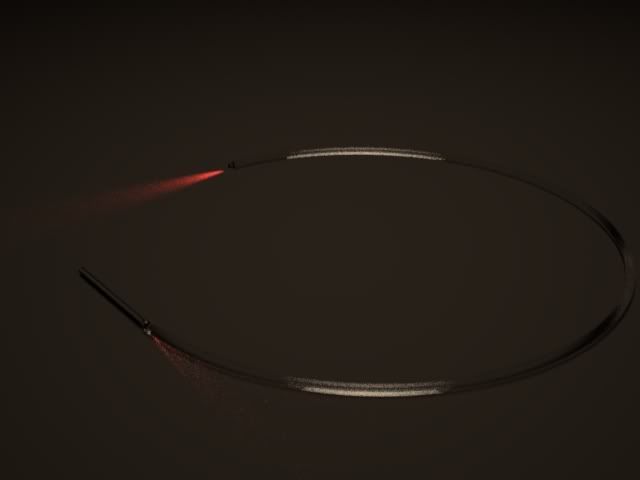
My fibre optic wire used edge overlapping geometries and transmitted light along the wire. If only the overlapping geometry were evident (tiny tube between the slightly bigger cylinder (0.1mm) within the tube of different Nd caldding), surely the light wouldn't have been transmitted effectively at all?

Image

Dave
OutDoor Scenery Question

Hi Ed, I wouldn't class myself as a Maxwell Pro, […]

fixed! thank you - customer support! -Ed