
All posts relating to Maxwell Render 1.x
By pipcleo
#275877
ok so they are intersecting geometries ?

thanks Fernando
User avatar
By KurtS
#275884
the volumes will intersect, but have no common surfaces!. If you make a hole for the water you will have intersecting surfaces. Simply let the glass be solid and place the water volume inside of it.

Image

Image
Last edited by KurtS on Tue Jul 15, 2008 5:11 pm, edited 1 time in total.
By pipcleo
#275891
ok success...thanks guys
even though logic would seem to dictate it shouldnt work this way with overlapping geometries

Image
User avatar
By Thomas An.
#275895
pipcleo wrote:even though logic would seem to dictate it shouldnt work this way with overlapping geometries
True. The shape of the glass ends up different than in real life ... and it is harder to do real-flow animations that way, but it is guaranteed to give you real life "looking" results.

Think of it this way...When the liquid volume is placed inside the glass, it actually acts as a liquid 'bubble' (you are not dissolving the liquid into the glass), it still acts as a foreign body.

KurtS ... that last test image of yours :) ... Sharp ! 8)
User avatar
By KurtS
#275900
Yes, Fernando - glassbubbles with air inside! ;)
By MS
#275901
Latest test. I merged those two glass boxes together to one mesh and I got light beam pointing right direction.

So very important note by Thomas from the morning:
A ray passes through a solid only if it encounters opening and then closing normals of the same mesh. Unlike in the past you can no longer have separate meshes (now you have to merge them to be considered a solid)
Modeling glass of water - probably nobody would like to split geometry to more then one mesh, but for example model of fish tank - all sheets of glass have to be merged together to one object (then to remove polygons which are "touching" water etc.)

Image
By MS
#276016
Sorry to bother you again with my questions, but...

There is another one.

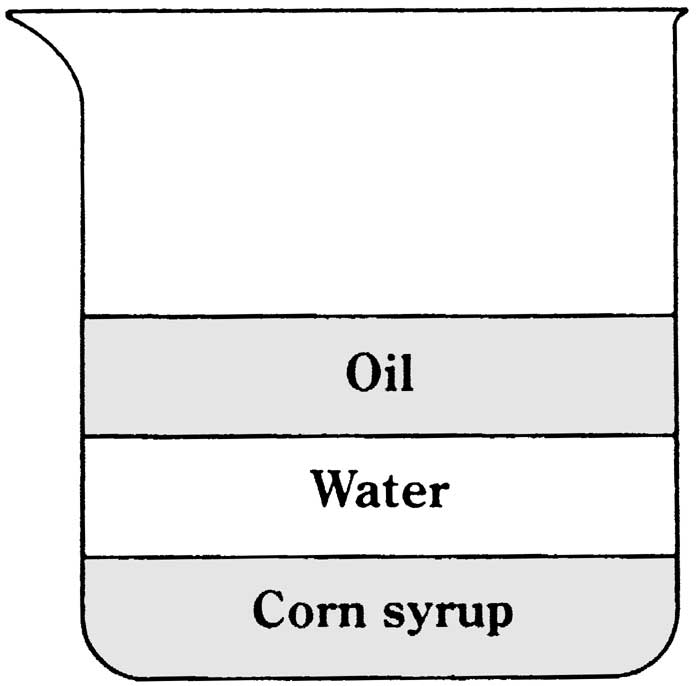
What are your tips for modeling something like this "water oil another liquids cocktail"?

Image
User avatar
By Thomas An.
#276019
Same thing as before.
I would keep them as closed volumes and all of them inside the glass volume with the oil-water and water-syrup surfaces being spaced infinitesimally apart (a very small gap).

So a ray entering from above will travel like:
Glass (inf)-->Oil-->glass(inf)-->water-->glass(inf)-->syrup-->glass

* where inf=smallGap
User avatar
By KurtS
#276026
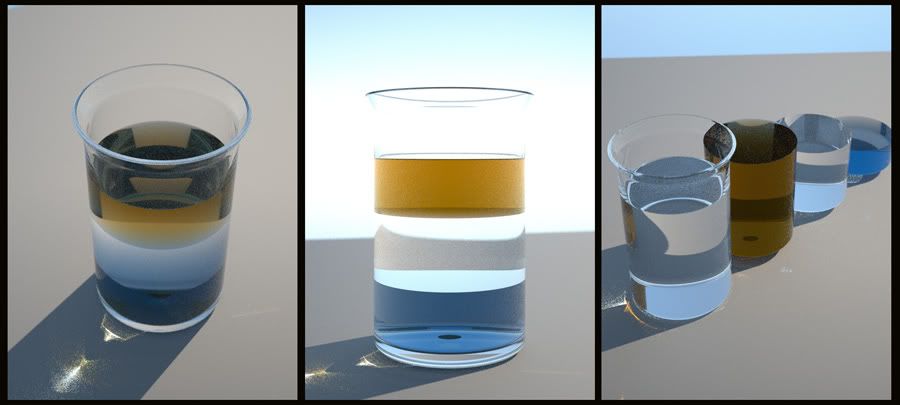
like this, i guess:

Image
User avatar
By KurtS
#276035
I'm using VRay - much faster!

(joke)


My method is slightly different form what Thomas suggests above, but I think both methods work. I'm also encosing all of the fluids in the glass volume, but modeled so that there is only one surface between each liquid.
User avatar
By iker
#276041
KurtS wrote:Image
KurtS , what a test! :shock: :shock: :shock:

Can you talk about your setup in this wonderful test?

User avatar
By Thomas An.
#276043
KurtS wrote:My method is slightly different form what Thomas suggests above, but I think both methods work. I'm also encosing all of the fluids in the glass volume, but modeled so that there is only one surface between each liquid.
Kurt's, Russian doll method works just as well ... Here is how they both look:
(basically they are equivalent, though I think the stacked method might be a little easier to model (?) )

Image
User avatar
By KurtS
#276044
iker wrote:KurtS , what a test! :shock: :shock: :shock:

Can you talk about your setup in this wonderful test?
thanks Iker,

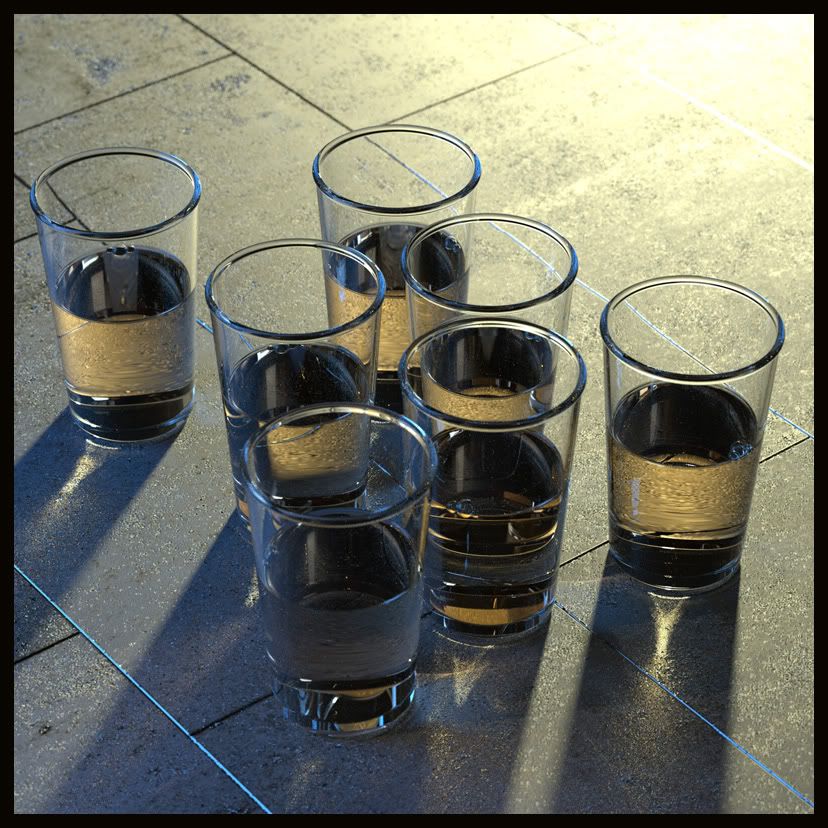
It's a simple setup: - two area lights, one of them is big and blue - the other one small and yellow. The smaller area light is creating most of the caustic patterns. And then there is a hdri map to generate some more reflections and an overall mood. No Sun and I'm using a medium long lens: 90mm. Floor material is some concrete texture from Arroway.
OutDoor Scenery Question

Hi Ed, I wouldn't class myself as a Maxwell Pro, […]

fixed! thank you - customer support! -Ed